
Langflow is one of the fastest growing open source low-code AI tools and was recently acquired by IBM (through their DataStax acquision). But here's what blew my mind - it wasn't built by some well-connected Silicon Valley team with endless funding. It was built by scrappy founders in Brazil who turned geographic disadvantage into their superpower.
Think about it: starting from a place where nobody knows you, building something the global dev community falls in love with, and scaling so fast that IBM comes knocking. That's the kind of story that makes you believe anyone, anywhere, can build something that matters.
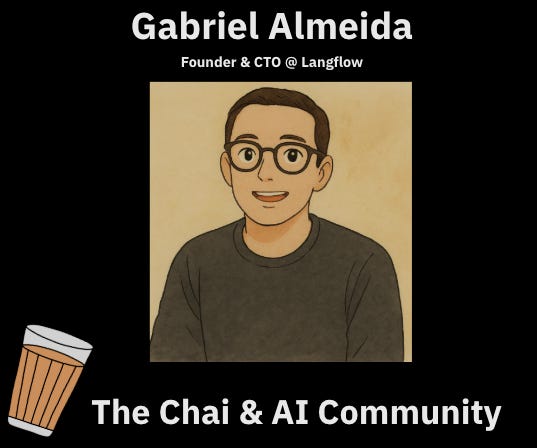
When I saw Gabriel Almeida (CTO, Langflow) comment on one of my LinkedIn posts, I knew this was my shot. Had to get him on our Chai & AI sessions with our community to spill everything.
What stood out to me in this session was Gabriel’s love for execution and the product. Founder–product fit is real, and I could feel it. Our community asked such thoughtful questions, and his answers made the conversation even more fun.
Here’s a summary of our session with him.
How did you get the idea for Langflow?
Gabriel: So me and my co-founder were doing data science consulting. We'd always talked about building this "brain" system that could connect AI models globally - like one model trained on finding crickets in plants talking to one that identifies bird species.
We were working on this data-centric ML tool - I wrote 6,000 lines of code in two days for our first prototype. Then ChatGPT happened in November 2022, and a few months later we discovered LangChain.
I was on Slack explaining LangChain to my partner, literally drawing boxes and lines. "You put an LLM here, tools here, connect them..." We looked at those drawings and thought "now I understand it, we should build that."
My partner asked if our interns could stop what they were doing and start building this. I found React Flow that night, texted him the link. Next day we pivoted. Less than a month later we shipped Langflow as open source.
Why open source instead of a paid product?
Gabriel: Honestly? We needed to get noticed. We were a small Brazilian team, less than 10 people, no one had ever heard of us. How do you get out there?
We loved open source - our whole careers were built on it. But the business decision was: open source will get us the most people. LangChain was so popular, we could ride that wave.
We only communicated in English, never used a single Portuguese word. We couldn't find much traction trying to sell it directly - we didn't know enough people as potential clients.
Got almost 1,000 GitHub stars in a few weeks. That's when VCs started talking to us.
Can you go hybrid - mix Langflow with custom code?
Gabriel: Yeah, that's a key piece. You can edit any component - it's just a Python class. You could build an entire LangGraph implementation inside one Langflow component if you wanted.
The other way works too. Langflow is essentially an API designer. The flow becomes an endpoint you can call from anywhere. So from LangGraph, you just call Langflow like any other tool.
I see it as a communication layer. Data scientists build flows, finance department uses them, engineers call them as APIs. Everyone connects without learning everyone else's tools.
What mistakes do you see people making with agents?
Gabriel: The biggest one? You want the agent to be Jarvis. People try to make one agent that knows everything and never makes mistakes.
Someone always comes to me saying their agent gets stuck in loops. I look at their setup - 15 tools, massive prompt, trying to do everything. I tell them: split it up. Make focused sub-agents with limited scope.
It's the same lesson we learn programming - make mistakes every 5 minutes, iterate fast, do one thing well. But people have to relearn this with every new technology.
What's your roadmap for observability and tracing?
Gabriel: We made a decision about a year ago - there are entire companies built just for this, like Langfuse and LangWatch. Should we compete with them or integrate?
We chose integration. If you set environment variables, Langflow will trace to Langsmith, Langfuse, whatever platform you choose. The experience isn't perfect yet, but it works.
We're still figuring out the UX. Do we make it invisible in the background, or do you add explicit tracing components to your flow? The second option is clearer but makes a 10-component flow need 30 components.
Any plans for AI auto-generating flows?
Gabriel: We're working on that! We call it "Vibe Flow" internally.
I built the graph infrastructure specifically for this - I wanted AI to write clean Python code like Keras, not massive JSON files. The system can already export Python graphs as JSON and auto-layout them on screen.
There are already working examples internally. You describe what you want, it generates the flow structure, you iterate from there.
What unsolved problems do you see in agentic AI?
Gabriel: I wrote this spec last July for "Langflow Actors System" - essentially event-driven agents watching task queues, triggering other flows asynchronously. Classic distributed systems but for AI.
Finished the draft on Thursday. LangChain announced "Ambient Agents" that Saturday. Later Anthropic dropped MCP with similar concepts. I independently thought of what all the big players were building.
The real challenge is efficiency. How do you make companies that aren't Google or OpenAI run 20 agents in parallel consuming thousands of tokens without spending rivers of money? That's where we might see real innovation.
What about multi-agent coordination at scale?
Gabriel: The Langflow actors system I built actually works really well for this. Agents can create tasks asynchronously, check back later, trigger other flows. All without writing code.
It's sitting in a branch - works great but we're still figuring out the product experience. Senior engineers at DataStax told me "this is just an event-driven system we've built at many companies." Not innovation in software engineering, but innovation in making it accessible.
Any lessons learned as a founder?
Gabriel: You have to stop and talk to people constantly. I get ideas from random conversations about what we're having for lunch. Someone mentions doing task A before task B, and suddenly I'm thinking about simple vs complex agent workflows.
As programmers, we tend to stay in our bubble, just grinding on the task in front of us. But talking to people gets you ideas in one day that would take two weeks to think of alone.
Also: I used to work every weekend, every waking hour basically. Now I don't work weekends, which is good. You have to slow down or you'll go crazy.
How's the acquisition been?
Gabriel: Really good actually. We went from less than 10 people to over 20 working directly on Langflow. Every meeting since the acquisition has been enlightening - working with people who've built this stuff for years.
DataStax built their company on Apache Cassandra, we built ours on GenAI. They learn from us about AI, we learn from them about scale and infrastructure. It's been a really good experience.
Even though I'm not strictly the owner anymore, seeing all these people pour their energy into building Langflow the same way we would - it feels really good.
Notes:
A large part of the summary is AI-generated from the transcript, with only a light pass from me. The goal here is to give you a quick glimpse of what was discussed for everyone’s benefit, not to turn it into a long, over-polished read.
The conversation is part of our Chai & AI sessions held with our community on Sundays. Chai & AI is an invite-only group of problem-first enterprise leaders and builders, talking about AI the way you would with a friend over chai. No script. No Agenda. No fuss.